By The Air Tutors Team · Updated November 10, 2026
November is College Application Month, one of the busiest stretches of senior year. With college applications, essays and financial aid forms all due at once, students, families and school counselors are juggling a lot. This season goes most smoothly when students lead, families support, and schools give everyone a clear map.
Early Decision and Early Action deadlines are landing, essays are getting their final polish, recommendation and transcript requests are stacking up, and the 2027-28 FAFSA is already open.
If your household or your counseling office feels a little stretched right now, that is completely normal. However, this is also when gaps become easy to see. For example, first-generation students and students without help at home can quietly fall behind on deadlines, essays and financial aid forms.
This is Part 1 of our guide to college applications. It walks through the steps to applying, the key dates to watch and what to know about the FAFSA right now.
Free printables below: Scroll down for a free College Application Tracker, a checklist for first-generation students and plain-language college terms guides. Print them at home or share them with students, families and counselors. Jump to the free printables.
What Are the Steps for College Applications?
Every student’s path looks a little different. Still, most college applications follow the same basic steps. Below is the order many students find easiest, along with notes on where schools can help.
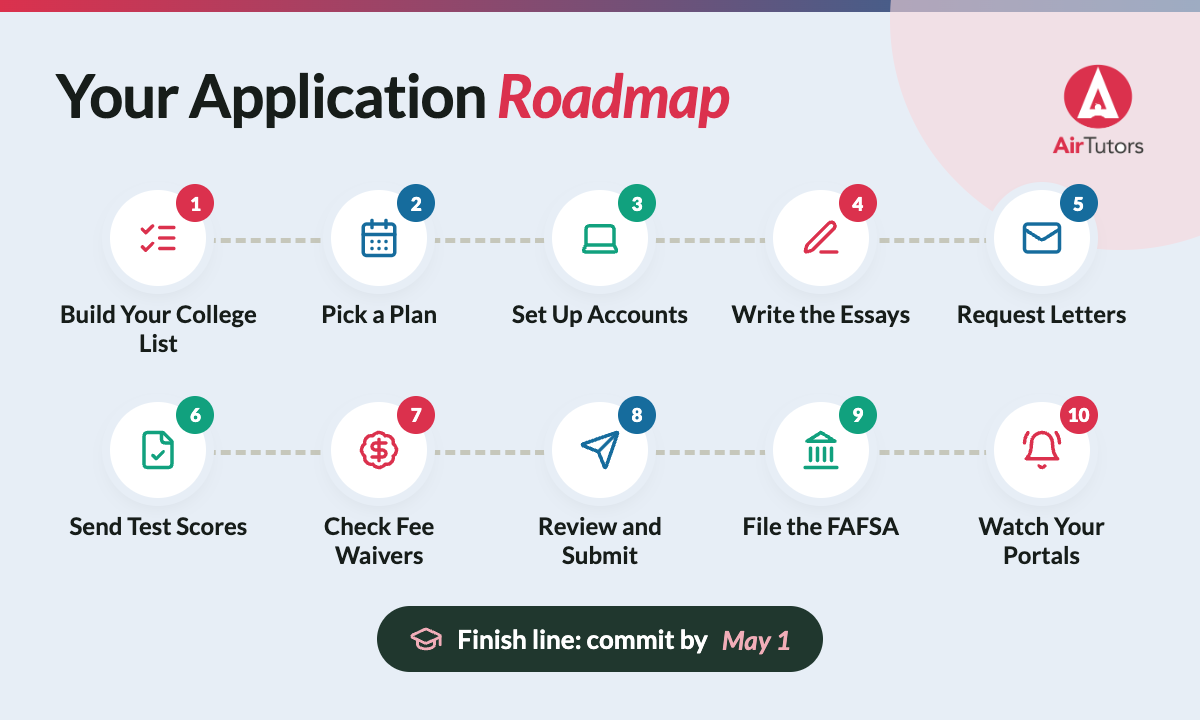
- Build a balanced college list. Include schools where admission is likely, possible and a reach. Also think about cost, programs and location. In addition, a short one-on-one with a counselor helps every senior get there.
- Pick a plan for each school. Decide whether each application is Early Decision, Early Action, Regular Decision or rolling.
- Set up application accounts. Most students use the Common App, and some colleges, like the University of California, have their own application. Meanwhile, lab, advisory or after-school work sessions give students time and help with portals.
- Write the essays. First, start with the personal statement. Then move on to the shorter supplemental essays each college asks for. Class or advisory time for brainstorming and feedback makes a real difference.
- Request letters and transcripts. Ask teachers and the school counselor at least three weeks before each deadline. After that, confirm how transcripts and school reports are sent.
- Send test scores if needed. Check whether each college requires, recommends or does not consider SAT or ACT scores.
- Check fee waiver eligibility. Eligible students may qualify for waivers through the Common App, College Board or NACAC.
- Review, submit and save proof. Proofread together, then pay the fee or request a waiver. Finally, keep every confirmation email.
- File the FAFSA. Submit it at StudentAid.gov, and complete the CSS Profile if a college asks for it.
- Watch portals and plan for spring. Colleges post missing items, interview invitations and decisions in each school’s portal. Then, in the spring, compare financial aid offers and commit by the common May 1 date.
What Are the Key Dates for Fall 2027 College Applications?
Because every college sets its own deadlines, the most important step is checking each school’s admissions page. Even so, most deadlines fall into a few windows:
- November 1 and 15: The most common Early Decision and Early Action deadlines.
- November 30: The University of California deadline and the Cal State priority deadline.
- Mid-December: Many early decisions are released.
- January 1 to 15: When most Regular Decision deadlines fall.
- January and February: When many colleges request mid-year reports with first-semester grades.
- May 1: The common date for students to commit to a college.
Quick tip: Aim to submit a few days before each deadline, because application portals can slow down on deadline day.
Is the FAFSA Open Now?
The 2027-28 FAFSA opened on September 23, 2026, and it uses 2025 tax information. Because many state and college aid programs are awarded first come, first served, filing sooner can help. Families can file and create FSA IDs at StudentAid.gov. In addition, some private colleges ask for the CSS Profile.
The FAFSA is just as important as college applications themselves. Schools can also help by hosting FAFSA nights with devices and staff on hand, and by keeping a simple roster of who has started, submitted and filed so no senior gets stuck.
Free Printables and Links for College Applications
- College Application Tracker (for students): A printable table where seniors track each college’s essays, letters, scores, transcripts and submission. Use it to keep college applications organized at the kitchen table, or hand it out in advisory or a college lab.
- First in Your Family, Ready for College: A printable one-pager for first-generation students, with a support-team guide, questions to ask colleges and an application checklist. Students can use it on their own, and counselors can share it with seniors and families.
- College Terms, Decoded (for parents): Plain-language definitions of the application and financial aid terms families hear most.
- College Terms, Decoded (for students): A student-friendly guide to the words seniors see in application portals and college emails.
- FAFSA at StudentAid.gov: The official site for filing the 2027-28 FAFSA and creating FSA IDs. Useful at home or at school FAFSA nights.
- Common App: The shared application many students use, with resources for counselors and recommenders.
- CSS Profile: The additional financial aid form some private colleges require.
- NACAC: Guidance for counselors, including information on application fee waivers.
Contact Us
Whether a student wants a second set of eyes on their writing, help staying organized through deadline season, PSAT, SAT or ACT prep, or support keeping first-semester grades strong, we’re here. Every student works with a consistent tutor, a real person who gets to know their goals.
Feel free to share the printables above with your students, families and counselors.

Scan the QR code to book a time to meet!
Schools and districts, if you would like to talk through support for your seniors this year, book a time with our team!
Want to learn more about Air Tutors? Watch the sizzle reel.
About Air Tutors
Air Tutors is founded and managed by graduates of the top universities all with a passion for teaching, mentoring and inspiring students to succeed.